

The Entity Home Page: Why Your About Page Is an AEO Asset
AI engines ground 'what is X' answers in one canonical page that defines your brand. How to build an entity home with Organization schema, sameAs, and consistent facts.
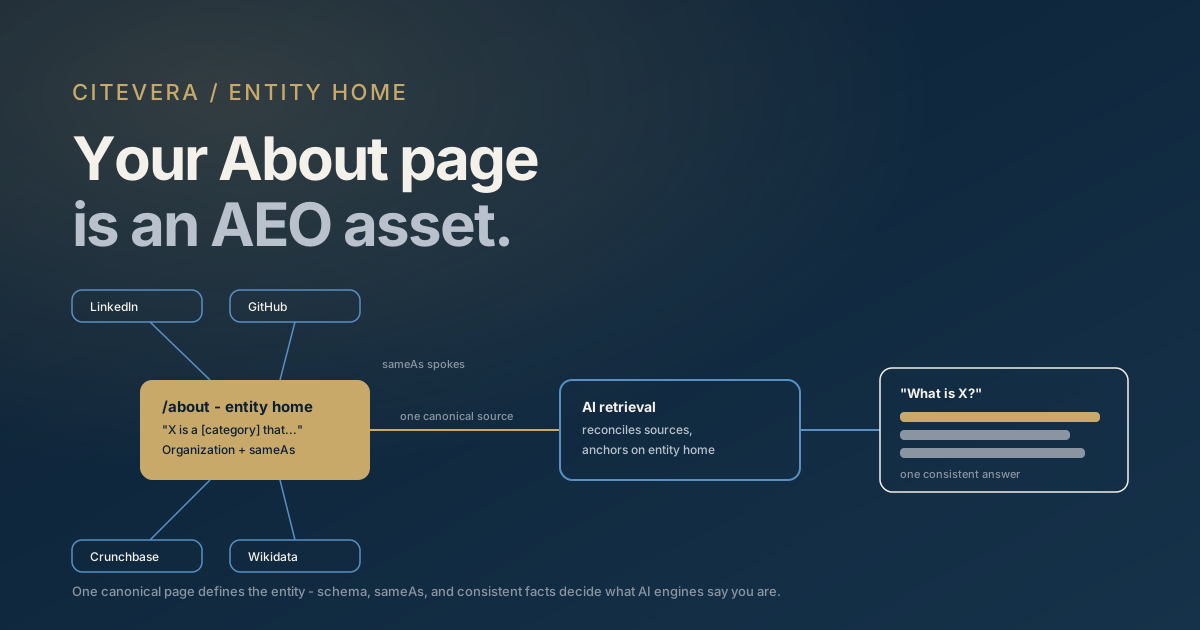
Every brand needs one page whose whole job is answering the question "what is X?" - one canonical URL where your name, what you do, who you serve, where you operate, and how you connect to the rest of the web are stated plainly and marked up in schema. Call it the entity home. For most companies it already exists as the About page, underloved and last edited two rebrands ago. When an AI engine has to describe your company, that page is disproportionately likely to be what it retrieves, quotes, and grounds its answer in.
That makes the About page something it has never been before: a conversion surface. Not for humans clicking a CTA, but for machines composing the first paragraph a prospect ever reads about you - inside ChatGPT, Perplexity, or an AI Overview, before they visit anything. If that paragraph is wrong, stale, or vague, the error came from somewhere, and the somewhere is usually you.
Here is why one canonical entity page beats scattered self-description, and exactly what to put on it.
How AI engines answer "what is X"
Mechanically, a "what is Citevera" or "who makes Product Y" prompt triggers the same pipeline as any retrieval query: the engine searches for documents about the entity, pulls the strongest candidates, and synthesizes. For brand-definition queries, the candidate set is predictable - your own site's self-description, your profiles on LinkedIn and Crunchbase, third-party mentions, and whatever knowledge-graph entries exist for you in places like Wikidata or the Google Knowledge Graph.
The engine now has to reconcile those sources. This is where most brands leak. If your homepage says you are "the revenue intelligence platform", your About page says "a sales analytics company", your LinkedIn says "AI-powered GTM insights", and Crunchbase still says what you were in 2022, the model is averaging four descriptions that disagree. The output is either mush ("a company offering various sales-related software solutions") or a confident repetition of the stalest source. We covered the disambiguation half of this problem - engines confusing you with similarly named entities - in our post on entity confusion; the entity home is the fix for the self-inflicted half.
A single canonical page changes the reconciliation math. It gives every pipeline the same authoritative document to anchor on: a page on your own domain, linked from your global navigation, marked up as being about the organization itself, and consistent with every external profile. You cannot control what third parties say, but you can make the strongest available source say exactly one thing.
What belongs on an entity home page
The test for every element: could a machine extract a clean, unambiguous fact from this? Write for extraction first, narrative second.
- A definition paragraph at the top. One to three sentences in the form "X is a [category] that [does what] for [whom]." This is the sentence you want quoted verbatim, so write it as if it will be - because it will. The same definition-paragraph mechanics that win citations for topic pages apply to the page about you.
- The stable facts, stated as facts. Founding year, headquarters location, legal name versus brand name, what the product actually is, pricing model in one line, who runs the company. Plain prose or a bulleted fact list both extract fine; vague mission poetry extracts as nothing.
- NAP-style consistency. Local SEO practitioners have preached name-address-phone consistency for years because directory reconciliation punishes drift. The same discipline now applies to every fact about you, everywhere it appears. Pick one canonical phrasing of your name, your one-line description, and your category, and use it byte-for-byte on the entity home, LinkedIn, GitHub, Crunchbase, your app-store listings, and your press boilerplate.
- Disambiguation, if you need it. If you share a name with a lens manufacturer or a 1990s band, say so explicitly: "Citevera is a software company and is not affiliated with..." Models handle explicit disambiguation well and ambient ambiguity badly.
- History that explains identity shifts. If you renamed or pivoted, one sentence - "Formerly known as X; renamed in 2024" - prevents engines from describing you as two different companies or, worse, as your old self.
Organization schema: the machine-readable spine
The visible page is for retrieval and quoting; the JSON-LD is for entity resolution. Your entity home should carry an Organization node that restates every fact on the page in structured form:
{
  "@context": "https://schema.org",
  "@type": "Organization",
  "@id": "https://example.com/#organization",
  "name": "Example",
  "legalName": "Example Software Inc.",
  "url": "https://example.com/",
  "logo": "https://example.com/logo.png",
  "description": "Example is a scheduling platform for veterinary clinics.",
  "foundingDate": "2021",
  "sameAs": [
    "https://www.linkedin.com/company/example",
    "https://github.com/example",
    "https://www.crunchbase.com/organization/example",
    "https://www.wikidata.org/wiki/Q00000000"
  ]
}
Three details carry most of the weight. The @id gives your organization a stable identifier that every other schema node on your site - articles, products, authors - can point at, so your whole site agrees about who published it. The description should be the same sentence as your on-page definition paragraph, not a second variant. And sameAs is the entity-resolution workhorse: it declares, in machine-readable form, that the LinkedIn profile, the GitHub org, and the Wikidata item are the same entity as this page. That is how a parser confirms it has found the real you rather than a namesake. The full property-by-property treatment is in our Organization schema deep dive.
Reference this node from every other page's schema rather than redeclaring the organization with slightly different values on each template - divergent copies of your own Organization markup are self-inflicted entity confusion.
One page, or facts scattered everywhere?
The scattered alternative fails for a mechanical reason: retrieval returns passages, and a fact diluted across ten pages produces ten weak passages instead of one strong one. When your founding year lives in a press release, your category in a footer tagline, and your headquarters in a careers page, no single retrieved document lets the engine compose a complete, confident description. The entity home concentrates the facts so one retrieval gets everything.
Concentration also simplifies maintenance, which is where consistency actually dies. When facts live on one page, an acquisition or repositioning means editing one page plus syncing profiles - a checklist, not an archaeology project. Add the entity home to your quarterly content review, and treat any external profile that drifts from it as a bug. This page-level work is half of entity alignment; the other half is making the rest of the web repeat your canonical phrasing often enough that engines stop hedging.
One structural note: the entity home does not have to be your homepage. Homepages are conversion surfaces that change with campaigns. An About page is stable, boring, and permanent - exactly the properties you want in a canonical reference. Link it sitewide from the footer or nav so both crawlers and internal PageRank can find it, and keep its URL alive forever.
Frequently asked questions
Is an entity home page the same as my About page?
Usually it becomes your About page, upgraded. The difference is intent: a traditional About page is written to charm a human visitor, while an entity home is engineered so a machine can extract who you are, what you do, and how you connect to your external profiles. You can and should serve both audiences on the same URL - the definition paragraph and fact list do not prevent you from also telling your story.
Do AI engines actually read schema markup?
Google documents structured data as an input to its understanding of pages and entities, and knowledge-graph construction generally leans on it. For retrieval-based engines the visible text does the quoting, but entity resolution - confirming that this site, that LinkedIn page, and that Wikidata item are one thing - is exactly what sameAs exists for. Schema is cheap, standardized, and the only channel where you state identity claims with zero ambiguity, so the practical answer is: yes, ship it.
What if my company has multiple products or brands?
Keep one Organization entity home for the company, and give each product its own page with Product or SoftwareApplication schema whose nodes point back to the organization's @id via brand or publisher. The failure mode to avoid is describing each product as if it were the company - that trains engines to conflate levels, and you inherit a different flavor of entity confusion.
How fast will fixing my entity home change AI answers?
Slower than you would like, faster than nothing. Query-time retrieval reflects a recrawled page within days to weeks, so engines that ground answers in live search can pick up your new definition paragraph quickly. Descriptions baked into model training data change only with model updates, which you do not control. Expect retrieval-backed answers to improve first and be patient with the rest.
Audit the page that introduces you
The entity home is a high-leverage fix precisely because it is one page: one URL to write well, mark up correctly, and keep in sync. A Citevera audit checks the AEO axis this page lives on - whether your Organization schema parses, whether your sameAs graph is present and coherent, whether a definition-shaped answer exists for an engine to lift - and generates the corrected JSON-LD for you to paste in. See how the scoring works, then go reread your About page the way a model would: as the single document that decides what the machines say you are.