

Ecommerce AEO: Winning Product-Discovery Queries in AI Search
Buyers research products through AI engines before clicking through to retailers. Here is how ecommerce sites win discovery, comparison, and review-stage queries.
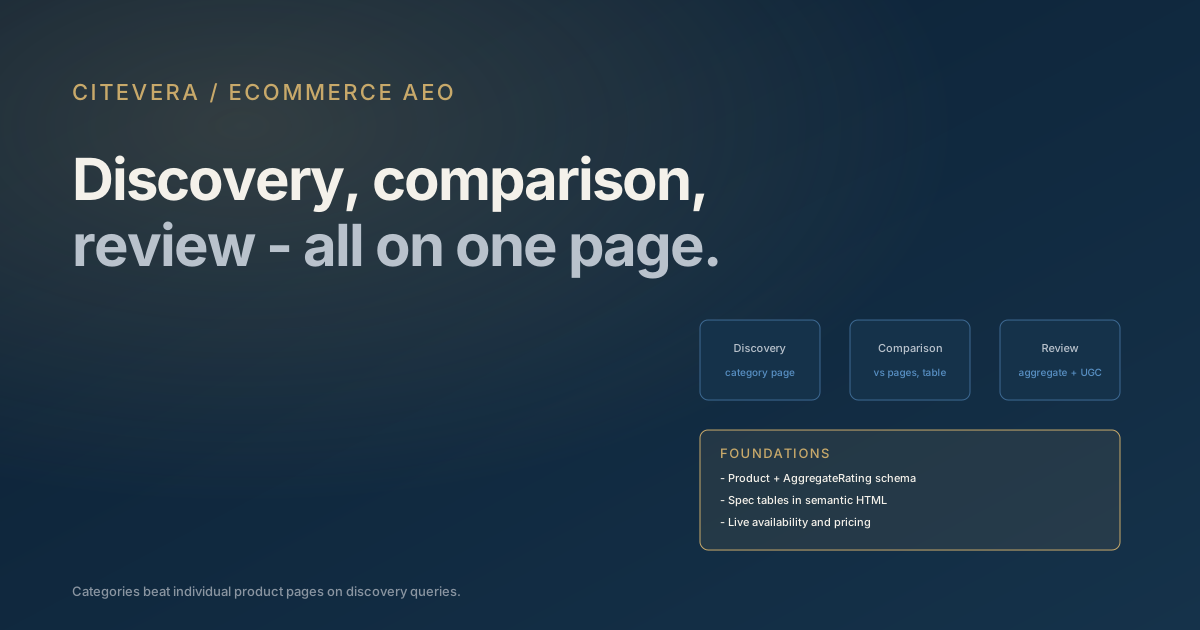
Ecommerce AEO is a different shape than B2B SaaS AEO. Buyers in retail and consumer ecommerce research products through AI engines at multiple stages: discovery ("what should I buy"), comparison ("which is best"), and review ("is X any good"). Each stage has different citation patterns and different structural requirements. Most ecommerce sites optimize for Google Shopping and stop, leaving the AI search citation flow on the table.
This post covers the buyer journey across AI engines, the ecommerce-specific structural patterns that earn citations, and the architectural decisions that compound across thousands of product URLs.
Why ecommerce AEO is structurally different from B2B SaaS
Three structural differences:
1. Far more URLs. A consumer ecommerce site has thousands of product URLs and hundreds of category pages, versus a B2B SaaS site's dozens. The AEO program has to scale to URL counts. 2. Lower per-URL editorial investment. You cannot write a 2,500 word pillar post for every product. Templates and structured data carry more weight. 3. Different intent distribution. Discovery, comparison, and review queries dominate over informational queries. The content shapes that win are different.
These differences mean ecommerce AEO is more about systematic structural decisions and less about heavy editorial investment per page.
The three buyer-research stages and what AI engines retrieve for each
Discovery stage
Query example: "what is the best ergonomic mouse for long typing sessions"
What AI engines surface: comparison and best-of content, not individual product pages. The engine retrieves third-party reviews, expert roundups, and category guides.
Implication for retailers: your category pages and curated "best of" content matter most at this stage. Individual product pages are secondary.
Comparison stage
Query example: "Logitech MX Master 3S vs Razer Pro Click Mini"
What AI engines surface: head-to-head comparison content, including the manufacturer pages, retailer pages with reviews, and third-party comparison sites.
Implication: your product pages matter, especially with AggregateRating and review excerpts. Comparison-page content (yours or third-party) drives the answer.
Review stage
Query example: "is the Logitech MX Master 3S worth the price"
What AI engines surface: detailed reviews, user feedback (Reddit, forums), AggregateRating signals, and price-history information.
Implication: your product page's review surface and AggregateRating quality matter most. Off-site reviews on Reddit and YouTube also factor in.
Product schema with AggregateRating: the ecommerce AEO foundation
Covered in detail in the Product schema and AggregateRating post. The summary for ecommerce specifically:
- Every product page should ship full Product schema with name, image, brand, sku, gtin, offers, and aggregateRating.
- AggregateRating must include reviewCount, not just ratingValue. Engines downweight ratings without sample size.
- review array should embed 5 to 10 representative reviews to corroborate the aggregate.
The Product schema layer alone meaningfully lifts ecommerce citation flow on review-stage queries.
Category pages: the most underleveraged AEO surface in retail
Most retailer category pages are thin: a list of products, a brief category description, and faceted filters. AEO-optimized category pages do more:
A 200 to 400 word category overview at the top
What is this category, who buys it, what to look for. Treats the category page as a citable answer for "what is X" queries.
A "how to choose" section
3 to 5 H3 sections covering the buying decision factors. "Battery life", "ergonomics", "compatibility", "price ranges". Each subsection 100 to 150 words.
A featured-products subset with editorial picks
Not every product, just 6 to 12 picks with a 30 to 50 word note on why each is featured. This produces the comparison content AI engines surface for discovery queries.
FAQ schema for the category
5 to 8 buyer questions covering common decision points. "What's the difference between X and Y in this category?" "How long do these typically last?"
A category page structured this way competes for discovery-stage queries that no individual product page can win.
Structured specifications and product attributes
Beyond Product schema, structured specifications help AI engines extract product attributes:
Specs tables in semantic HTML
Use <table> with proper <th> headers:
<table>
  <thead><tr><th>Attribute</th><th>Value</th></tr></thead>
  <tbody>
    <tr><th>Weight</th><td>141 g</td></tr>
    <tr><th>Battery life</th><td>70 days</td></tr>
    <tr><th>Connectivity</th><td>Bluetooth 5.0, USB-C</td></tr>
  </tbody>
</table>
This table format extracts cleanly into AI answers when users ask spec-specific questions.
Avoid attribute-as-bullet patterns that lose context
Bullet lists like "- 141 g - 70 day battery - Bluetooth 5.0" extract as a list but do not connect to the attribute label. The semantic table preserves the attribute-value pair.
PropertyValue schema for power users
Schema.org's PropertyValue can be embedded in additionalProperty arrays on Product schema:
"additionalProperty": [
  {"@type": "PropertyValue", "name": "Weight", "value": "141", "unitCode": "GRM"},
  {"@type": "PropertyValue", "name": "Battery life", "value": "70 days"}
]
Few engines use PropertyValue today, but it is forward-compatible and costs little to ship.
Reviews: the corroboration layer for ecommerce
Reviews are the ecommerce equivalent of B2B "case studies": they corroborate product claims with independent voice. Three patterns matter:
On-page reviews with structured Review schema
Each review embedded with author, datePublished, reviewBody, and ratingValue. Limit to 5 to 10 most-helpful reviews on the product page; longer review feeds belong on a separate /reviews URL.
Third-party review platforms (Yotpo, Trustpilot, Bazaarvoice)
These platforms aggregate reviews and ship structured data. The trade-off: reviews live partly on their domain, partly on yours. Choose a platform that allows your domain to retain primary canonical and Review schema.
User-generated content from Reddit, YouTube, and forums
Off-site reviews show up in AI engine responses for review-stage queries. Engaging genuinely with communities (not astroturfing) builds the third-party review surface. The Reddit and forum citations post covers the broader pattern.
Pricing transparency and AEO
AI engines surface pricing in answers when retailers expose it cleanly:
- Display price prominently in the page and in Product schema's offers.priceSpecification.
- Update offers.priceValidUntil when prices change.
- For sale prices, use offers.priceValidFrom to express the duration.
- Show MSRP separately if you want the comparison anchor visible.
Hidden prices ("contact for pricing", "see in cart") rarely surface in AI answers. For commodity ecommerce, this is a citation cost.
Inventory and availability signaling
availability in Product schema tells engines whether the product is purchasable:
https://schema.org/InStockhttps://schema.org/OutOfStockhttps://schema.org/PreOrderhttps://schema.org/Discontinued
Stale availability data is worse than no data. Sites that ship "InStock" while actually out of stock erode trust signals over time. Wire your availability schema to actual inventory counts.
Image and visual content for ecommerce AEO
Three patterns:
- High-resolution product images with descriptive alt text that includes the product name and key attributes.
- Multiple image angles in the Product schema's image array.
- Lifestyle imagery alongside product shots when relevant. Engines surface these in image-rich answers.
The image and video inclusion post covers the broader visual content pattern.
What about marketplaces vs DTC?
Two platform-shape considerations:
Marketplace listings (Amazon, Walmart, Etsy)
Citations to your marketplace listing benefit the marketplace, not your domain directly. Strong marketplace presence still matters because reviews aggregate there, but the domain-level entity flow is weaker.
DTC (direct-to-consumer)
Your own domain captures all the entity flow. Worth investing in DTC AEO even when most revenue runs through marketplaces, because the brand entity strength compounds and supports marketplace listings indirectly.
Key takeaways
- Ecommerce AEO scales through structural decisions across thousands of URLs, not heavy editorial per-page.
- Three buyer stages (discovery, comparison, review) have different citation patterns and content needs.
- Category pages are the most underleveraged AEO surface in retail.
- Product schema with AggregateRating and structured specifications is the foundation.
- Reviews on-page, on third-party platforms, and on Reddit/forums together build corroboration.
What to do next
Run a free audit at scan.citevera.com to see whether your category pages have overview content and whether your product pages ship complete Product schema with AggregateRating.
For schema specifics, Product schema and AggregateRating covers the structured-data layer in depth.