

Controlling What AI Says About Your Brand
When buyers ask AI if your product is legit, what it costs, and what the alternatives are, engines answer from sources you can influence. How to own each query.
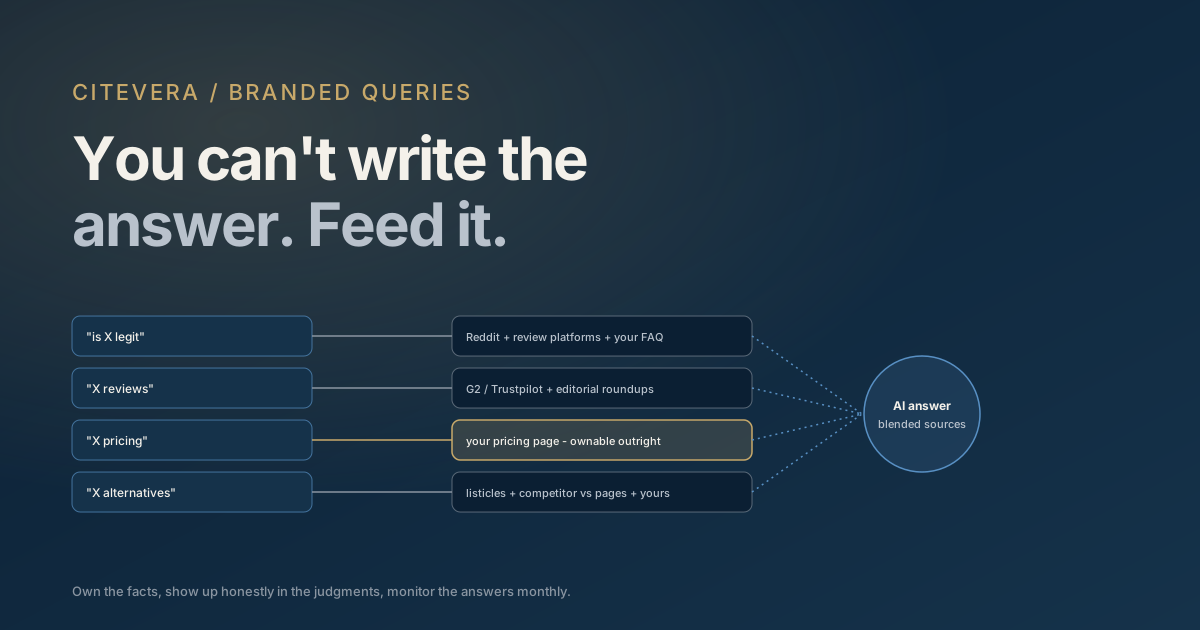
Somewhere right now, a prospect is typing "is [your brand] legit" into ChatGPT, and the answer is being assembled from whatever sources the engine can retrieve: your site if it is crawlable and says something useful, Reddit threads and review platforms if not. You do not get to write the answer. You do get to influence every input it is built from - and most brands leave those inputs to chance.
Branded queries are the highest-stakes surface in AI search because the person asking is already deep in your funnel. Nobody asks "is X legit" about a product they have not considered buying. This post breaks down the four branded query families, which sources engines actually pull for each, and how to own the answer with honest pages rather than reputation tricks.
The four branded query families
Branded prompts cluster into four shapes, and each one triggers a different retrieval pattern.
- Trust queries: "is X legit", "is X a scam", "is X safe". The asker wants third-party confirmation, and engines behave accordingly: they weight community and review sources - Reddit, Trustpilot, app-store reviews, forum threads - alongside your own site. Your domain saying "we are legit" is weak evidence by construction; the engine is specifically looking for voices that are not you.
- Evaluation queries: "X reviews", "is X worth it", "X pros and cons". Retrieval leans on review platforms (G2, Capterra, Trustpilot in B2B and consumer respectively), editorial roundups, and comparison articles. Your site contributes framing - what the product does, for whom - but the verdict passages usually come from third parties.
- Fact queries: "X pricing", "how much does X cost", "does X have a free plan". These are the queries you can own outright. The authoritative source for your price is you, and engines know it. They fail over to third parties - stale review-site listings, forum guesses - only when your pricing page is uncrawlable, vague, or hides the numbers behind "contact sales".
- Substitution queries: "X alternatives", "X vs Y", "sites like X". Retrieval pulls listicles, comparison pages, and community recommendation threads. This is the family where competitors are actively writing about you, and where an engine will happily cite a rival's "X alternatives" page as its main source about X.
The pattern across all four: engines diversify sources deliberately on branded queries, mixing owned, editorial, and community voices. Your goal is not to be the only source. It is to be the best-structured source for the facts, and well-represented in the voices the engine trusts for the judgments.
Own the fact queries completely
Pricing is the test case. A transparent pricing page - real numbers, plans compared in text (not only in a JS-rendered widget), a plain-prose answer to "what does X cost" - gives engines a passage they can quote with confidence and a reason never to ground your pricing answer on a third-party listing that went stale two price changes ago. If your model genuinely requires custom quotes, publish the structure anyway: starting price, what drives the quote, an example. "Contact sales" as the only pricing content is an instruction to the engine to go ask someone else, and it will. We cover the page patterns in detail in product and pricing page AEO.
The same logic covers every fact about you: supported integrations, data handling, refund policy, company location and age. Each is a branded prompt someone will type. Each deserves a crawlable page with a direct-answer paragraph, marked up with accurate Organization schema so the entity resolution is clean. Fact queries are the cheapest wins in AI search: no competition for authority, no third-party persuasion needed, just retrievable clarity.
Compete honestly on the judgment queries
Trust and evaluation queries cannot be owned, but they can be entered.
- A real reviews or customer-stories page. Not adjectives - named customers, specific outcomes, dates, and links to the original reviews where they live on G2 or Trustpilot. Sourced testimony gives engines quotable passages tied to verifiable third parties, which is the closest an owned page gets to independent evidence. Fabricating or laundering reviews is the one move worse than doing nothing, since review platforms and engines both cross-check.
- An honest FAQ that meets the trust query head-on. A page that answers "Is X legit?" in plain prose - how long you have operated, how many customers, security posture, refund terms - gives the engine an owned passage to blend with the community voices instead of leaving your side of the story unretrievable.
- Your own alternatives and vs pages. If you do not publish "X vs Y", only your competitors' version of that comparison exists to be cited. A fair comparison page that concedes real trade-offs is more citable than a promotional one, precisely because balanced passages survive an engine's usefulness filter. The structural patterns are in comparison page AEO.
Monitor what the engines actually say
You cannot manage an answer you have never read. The monitoring loop is simple and worth doing on a schedule.
Step 1 - build a branded prompt set. Ten to twenty prompts across the four families: "is [brand] legit", "[brand] reviews", "[brand] pricing", "[brand] alternatives", "[brand] vs [top competitor]", plus the category question you most want to appear in.
Step 2 - run them across engines monthly. ChatGPT, Claude, Gemini, Perplexity. Fresh sessions, no account context. Record the answer, the sentiment, and every cited URL.
Step 3 - triage by source. A wrong price cited from your own page is a content fix. A wrong price cited from a stale G2 listing means updating your G2 profile. A "legit" answer grounded on one angry Reddit thread from 2023 tells you exactly which surface needs a response. The cited URL, not the answer text, is the actionable datum.
Step 4 - track drift over time. Answers change as indexes refresh and models update. What you fixed in March can regress in July when a new model version weights sources differently. This is why monitoring is a loop and not an audit. Our guide to free brand-mention monitoring covers the manual version; every paid Citevera plan bundles automated citation monitoring across ChatGPT, Claude, and Gemini so the loop runs without a human remembering to.
Responding to negative UGC the legitimate way
When monitoring surfaces a damaging Reddit thread or a one-star pile-on feeding the engines, there is a right way and a self-immolating way to respond.
The legitimate playbook: reply in the thread as the company, clearly identified, addressing the specific complaint - engines retrieve the whole thread, so a substantive vendor response becomes part of the retrieved context and often part of the answer. Fix the underlying issue and say so with dates. Respond on the review platforms through their official vendor channels. And where a complaint is factually wrong, publish the correct fact on an owned page so engines have a counter-source to weigh.
What never works: astroturfing replies, buying reviews, or mass-flagging criticism. Platforms detect it, communities document the detection, and the documentation itself becomes high-engagement content about your brand - the sentiment mechanics of AI mentions mean a caught manipulation attempt is strictly worse input than the complaint it tried to bury. Negative mentions are survivable; a thread titled "X is astroturfing" is the kind of source engines quote verbatim.
Frequently asked questions
Can I just tell AI companies to correct what their models say about my brand?
There is no reliable correction channel, and answers are generated per-query from retrieval anyway - there is no single stored "answer about you" to edit. The dependable lever is the source layer: publish the correct facts where crawlers can get them, improve the third-party record, and the answers follow.
How long until fixes show up in AI answers?
It varies by engine and by which layer answers the query. Retrieval-augmented engines like Perplexity can reflect a crawlable page change within days; answers drawn from model training move on model-release timescales, in months. Ship fixes to crawlable pages, keep them stable, and verify through your monthly monitoring runs rather than assuming a timeline.
Should I publish a page literally titled "Is [brand] legit?"
If the query volume exists, yes - as an honest FAQ answer, not a defensive rant. Answer it the way a fair third party would: age, customers, security, guarantees, with links out to independent profiles. The page will rarely be the only source cited for the query, but it reliably earns a seat in the blend, which is the realistic goal.
My competitors' "alternatives to us" pages outrank ours. Does that matter in AI answers?
Yes, because those pages get retrieved for the substitution queries about your brand, and their framing leaks into answers. You counter by publishing your own comparison and alternatives content that is genuinely more useful - current, specific, honest about trade-offs - so engines have a better-structured source for the same query. Conceding that surface means the only detailed writing about you was written by people paid to beat you.
See your brand the way the engines do
The fastest way to find out what AI says about you is to ask it, systematically. A Citevera audit scores whether your owned pages - pricing, FAQ, comparisons - are crawlable and structured well enough to be the source, and the bundled monitoring in every paid plan runs your branded prompts across ChatGPT, Claude, and Gemini every cycle so drift shows up as a dashboard change, not a lost deal. Own the facts, show up honestly in the judgments, and check the answers monthly - that is the whole playbook.