

Why Bing Still Matters for ChatGPT Visibility
ChatGPT Search's retrieval has leaned on Bing's index, so a page missing from Bing can be missing from ChatGPT answers. How to verify and fix your Bing coverage.
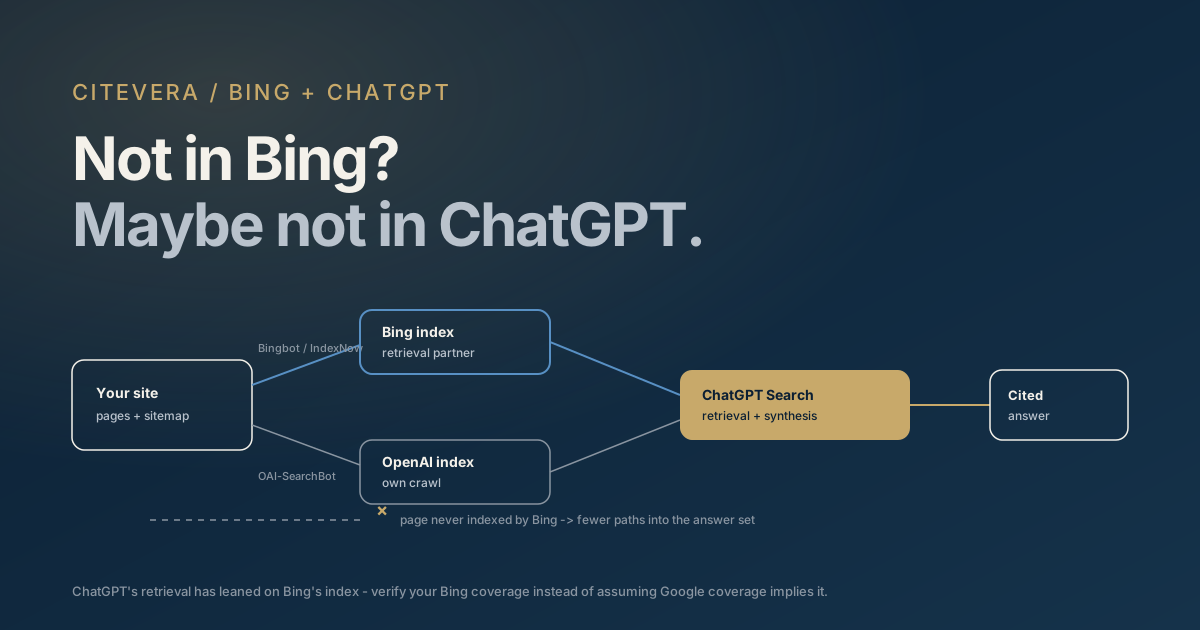
If your pages are not in Bing's index, there is a real chance they cannot appear in ChatGPT's search-backed answers. When OpenAI launched ChatGPT Search, it stated publicly that the search model works with third-party search providers and named Microsoft Bing as a key one, and reporting since has consistently described Bing as a backbone of its retrieval. OpenAI also crawls the web itself with OAI-SearchBot, so Bing is not the only door - but it is a load-bearing one, and it is the one most sites have quietly neglected for a decade.
The practical takeaway is simple: verify your Bing coverage instead of assuming Google coverage implies it. Most teams have never opened Bing Webmaster Tools, have never checked how many of their URLs Bing actually indexed, and have tuned every technical decision for Googlebot alone. That neglect was nearly free in 2020. In 2026, with ChatGPT sitting on top of Bing-flavored retrieval, it is a visibility gap you can measure and close in an afternoon.
Here is how the dependency works, how to check where you stand, and the specific Bing indexing gaps we see most often.
How ChatGPT retrieval relates to Bing's index
Be precise about the claim, because overclaiming here is how bad advice gets written. ChatGPT's model does not "search Bing" the way a human does. When a prompt triggers retrieval, the system issues search queries to its retrieval layer, gets back candidate documents, fetches or reads some of them, and synthesizes an answer with citations. OpenAI has documented that this pipeline incorporates third-party search providers - Bing being the publicly named one at launch - alongside OpenAI's own crawling and indexing via OAI-SearchBot.
Two consequences follow from that architecture:
- Absence from Bing narrows your funnel. If the candidate set is drawn substantially from Bing's index, a page Bing never indexed has fewer paths into the answer, no matter how well it ranks on Google.
- Bing ranking signals inherit relevance. A retrieval layer built on a search index does not just check membership - it uses that index's notion of which pages are worth returning for a query. Being indexed but buried is better than absent, and being genuinely competitive in Bing is better still.
One honest caveat, stated plainly: retrieval pipelines are internal, unversioned, and change without announcement. Nobody outside OpenAI knows the current percentage mix between Bing, OpenAI's own index, and other sources, and anyone quoting one is guessing. That uncertainty is an argument for covering Bing, not against it - it costs little, and every plausible mix includes it. The same logic covers Microsoft Copilot for free, which sits directly on Bing.
Check your coverage before you fix anything
Start with a site query. Run site:yourdomain.com on Bing and compare the result count and the specific pages against what you expect. Site-operator counts are estimates on every engine, but the failure mode you are looking for is not subtle - it is the site with 400 published pages and 30 in Bing.
Spot-check the pages that earn AI citations. Search Bing for exact titles of your best comparison pages, documentation, and definition posts - the content types that actually get cited by answer engines. If your money pages are missing while your homepage is indexed, you have a crawl-depth or quality-threshold problem, not a discovery problem.
Then get the real data. Everything past this point needs Bing Webmaster Tools, which is the only authoritative view of what Bing has crawled, indexed, and rejected.
Setting up Bing Webmaster Tools properly
Setup is fifteen minutes, and one shortcut makes it five: Bing Webmaster Tools can import your verified sites directly from Google Search Console, carrying over ownership verification. Otherwise, verify with a DNS CNAME record, an XML file upload, or a meta tag - the same options you know from Google.
Once verified, do four things:
- Submit your XML sitemap. Under Sitemaps, submit the same sitemap you give Google. If your sitemap has structural problems - stale lastmod dates, dead URLs, redirect chains - Bing is less forgiving about them than Google tends to be.
- Read the Site Explorer and index coverage views. This is where you learn which URLs Bing knows about, which it indexed, and which it excluded, with reasons. Treat exclusions with "quality" flavored reasons seriously; Bing applies its thresholds independently of Google's judgments.
- Run the URL Inspection tool on your key pages. It shows you the page as Bingbot fetched it, including whether rendering produced your actual content. If your content only exists after client-side JavaScript runs, this is where you find out how much of it Bing actually sees - the SSR versus CSR problem hits Bing at least as hard as it hits AI crawlers.
- Check the Crawl control settings. Some sites, or their predecessors' configurations, throttle Bingbot aggressively. Make sure you are not rationing the crawler you now care about.
IndexNow: push instead of wait
Bing crawls the open web less exhaustively than Google, so passive discovery of new and updated URLs is slower. IndexNow exists to fix exactly this: it is an open protocol, adopted by Bing and other engines, that lets you push URL changes to the index instead of waiting for a crawl. You host a key file, then ping an endpoint with changed URLs - the whole protocol is a single HTTP request:
POST https://api.indexnow.org/indexnow
Content-Type: application/json

{
  "host": "yourdomain.com",
  "key": "your-generated-key",
  "keyLocation": "https://yourdomain.com/your-generated-key.txt",
  "urlList": [
    "https://yourdomain.com/blog/new-post",
    "https://yourdomain.com/pricing"
  ]
}
The practical routes to adoption, easiest first: many CDNs and platforms have one-click IndexNow integration; WordPress sites get it from several SEO plugins that submit on publish automatically; custom stacks can add the ping to their deploy or publish hook in a few lines. The protocol details live at indexnow.org. For a site that publishes or updates content weekly, IndexNow collapses Bing's discovery lag from "whenever Bingbot wanders by" to minutes - which matters when content freshness affects citation selection.
The Bing gaps a decade of Google-only SEO created
These are the patterns we see repeatedly when a Google-healthy site turns out to be half-invisible on Bing:
- Bingbot blocked or throttled in robots.txt or the WAF. Years of bot-management rules tuned to "allow Googlebot, be suspicious of everything else" quietly degrade Bingbot. Check your CDN's bot rules, not just robots.txt - a challenge page served to Bingbot is an empty index entry.
- JavaScript-dependent content. Bing renders JavaScript, but less patiently and less completely than Google. Content that appears only after hydration, infinite scroll, or client-side routing loses more in Bing than it does in Google.
- Weak canonical and redirect hygiene. Bing is more literal about canonical signals and redirect chains. A messy www/non-www split or a chain of legacy redirects that Google untangles can leave Bing indexing the wrong variant or nothing.
- No sitemap submission, ever. Google found you through links in 2014 and never lost you. Bing may simply never have crawled deep sections of your site. Submission is free; do it.
- Thin-page exclusions. Bing's quality bar excludes pages Google tolerates. If large template-generated sections are missing, consolidate before you resubmit.
None of this is exotic. It is ordinary technical SEO, applied to an engine you stopped watching - and it is the same infrastructure work that AI crawlers in general depend on.
Frequently asked questions
If I rank well on Google, am I covered for ChatGPT?
Not automatically. Google's index feeds Google's surfaces - AI Overviews, AI Mode, Gemini. ChatGPT's documented retrieval path runs through third-party providers, publicly anchored on Bing, plus OpenAI's own crawl. A page absent from Bing can be invisible to that pipeline regardless of its Google rankings. Verify in Bing Webmaster Tools rather than inferring.
Does OpenAI still use Bing today?
OpenAI named Bing as a search partner when ChatGPT Search launched and has been building its own crawling and indexing with OAI-SearchBot since. The current blend is not public and can change without notice. The resilient strategy is to be present in both: keep Bing coverage healthy and make sure OAI-SearchBot can fetch your pages.
Is IndexNow worth it for a small site?
Yes, because the cost is near zero. One key file plus an automated ping on publish gets your changes into Bing's pipeline in minutes instead of days or weeks. On a small site the absolute gain is modest, but it removes an entire class of "Bing has not noticed yet" problems for one hour of setup.
Should I block Bingbot to save crawl budget?
No. For most sites crawl budget concerns are overstated, and Bingbot's load is modest. Blocking or throttling it now cuts you out of Bing, Copilot, and any AI retrieval that leans on Bing's index - a wide blast radius for a negligible saving. If you rate-limit bots at the CDN, whitelist Bingbot explicitly alongside Googlebot.
Verify the whole chain, not just one link
Bing coverage is one link in your ChatGPT visibility chain. The others - can OAI-SearchBot fetch your pages, does your robots.txt say what you think it says, does your content parse cleanly once retrieved - fail just as silently. Citevera's free AI crawler access checker tests any URL against the major AI crawler user agents and shows the exact rule producing each verdict, and a full Citevera audit scores the crawlability and answer-readiness of the site behind them. Check Bing this week, check the crawlers the same day, and you have covered both doors ChatGPT can walk through.